
When a family starts searching for a residential care home, they often begin by checking basic physical criteria: “Is it clean?” “Is it safe?” Does it look good?” Once those topics are checked in, the most critical question is: “Who will be there at 2:00 AM to provide the person-centered support my loved one needs if she is scared or confused?”
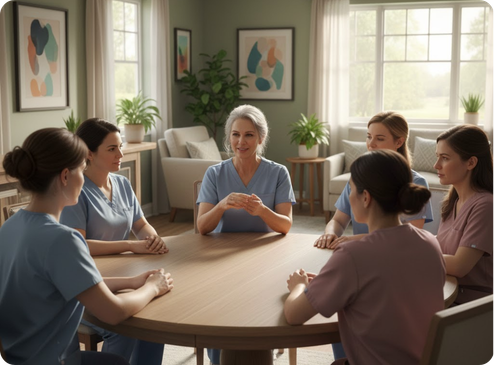
At Harriet Residential Care, we know that a caring structure is only as good as the people who run it. The best measure of a group home is the caliber of its caregivers. That is why we put in great effort into specialized training that goes way beyond what is required by law. We don’t just train for compliance; we train for connection. We equip our team with advanced skills that allow us to give high-grade safety and highly personalized care every single day.

Exploring the Code of Behavior
For most people with Intellectual and Developmental Disabilities (IDD), behavior is the common channel for communication. A resident who is at her wits’ end may not be able to say, “The room is too loud,” or “I’m missing my family,” but will instead express it through action. Traditional responses to behavioral challenges usually address only the surface action, which, in turn, may completely miss the underlying issue and, even worse, become the catalyst that further increases distress.
Our team has received training in Positive Behavior Support (PBS), which focuses on person-centered support and evidence-based practices. Instead of reacting to a challenge, our personnel are trained to get to the bottom of the issue; they become behavioral detectives as we examine patterns that may trigger issues and determine the root of the unmet need, which may be sensory, emotional, or communication-based.
By learning this special language, our staff can de-escalate issues with grace, patience, and professional skill. For Harriet, this approach is the foundation of proper person-centered support, which prioritizes the individual’s experience over the behavior itself, ensuring that all feel heard, safe, and respected.
Person-Centered Support: The “She” in Our Approach
A protocol may be helpful to address specific situations, but we never forget a vital fact in our person-centered support program: every individual is different. We do not support a one-size-fits-all model; instead, during our training sessions, we emphasize Personal-Centered Planning (PCP), which goes beyond a generic checklist. In other words, we focus on answering essential yet straightforward questions such as:
- What is the resident’s history?
- What are their hobbies and preferences?
- What goals are they aiming for?
This philosophy changes care from a series of check boxes into a team-based approach.
Now, this level of person-centered support requires attentive, continuous learning, and our staff is trained to know not just the clinical history of each individual, but also their personal histories. For example, in some cases, a resident finds great peace in folding laundry, while another requires ten minutes of quiet time with a weighted blanket post-doctor’s appointment, or even that certain songs may instantly change someone’s mood.
This knowledge about residents is like a living document we care for and tailor each day. We focus on a fine-tuned, individual care that turns basic “care giving” into a very profound “sense of belonging”, creating the foundation for a high-quality, person-centered support.
Safety Via De-escalation Techniques
Safety is always a priority in every planning we do, and this means not only physical safety but also emotional safety. At Harriet, every team member is certified in advanced, trauma-informed de-escalation techniques that prioritize non-verbal cues and environmental modulation over physical intervention. Our training includes:
- Identifying Triggers: Staff are trained to see the first signs of anxiety or sensory overload, something that is usually associated with changes in breath rate, withdrawal, or increased stimming right before a crisis starts.
- Environmental Adjustment: We believe in quickly yet calmly adapting the environment to a person’s needs. This may include dimming the lights, offering noise-canceling headphones, reducing verbal requests, or creating a physical space to help a resident self-regulate.
- Compassionate Presence: In the training, we practice postures that are calm and non-threatening, and we use a very reassuring tone, which in turn makes the resident feel secure and supported, not put on the defensive.
This extends our person-centered support into a proactive safety model based on identifying each individual’s unique triggers and calming strategies, which, in turn, prevents distress and emotional crisis.
Ongoing Emotional Intelligence Development
Technical skills are a must, but it is emotional intelligence (EQ) that truly defines the quality of care. We run regular workshops focused on empathy, mindful communication, active listening, and the health of our care team. We train our staff in “emotion coaching,” a technique that focuses on validating feelings and naming emotions with our residents.
At Harriet, we believe that to provide consistent, compassionate care, caregivers must be cared for. We put in place training in resilience, boundary setting, and stress management, three key strategies that are key to our teams’ well-being. A team supported by its environment will have the patience, skill, and concentration to deliver the best possible caregiving services.
This investment in our staff’s emotional health is essential to the quality of our person-centered support, guaranteeing that every interaction is founded in patience and understanding.
Trust in the Team at Harriet
We are fully committed to the care of your mother, sister, or daughter, a job that we at Harriet take very seriously. Our high-level staff training, combined with a consistently low staff-to-resident ratio, means that the “Heart of Harriet” is not just a metaphor; it is the daily reality of compassionate, competent care.
Our staff training process ensures that safety is a priority in all we do and that person-centered care is a practiced (not a promised) standard. It also guarantees that the person at your loved one’s side at all times is not just a staff member, but a highly skilled and compassionate professional dedicated to that person’s dignity and well-being.
To see what our staff bring to the table and to learn more about our dedication to outstanding person-centered support, we encourage you to check out our “Why Us” page or drop us a line to set up a time to chat.
